Cottage Row article first published in Historical Society of Michigan, Michigan History Magazine, July/Aug 2022
Cottage Row: A Haven for Summer Rest and Relaxation
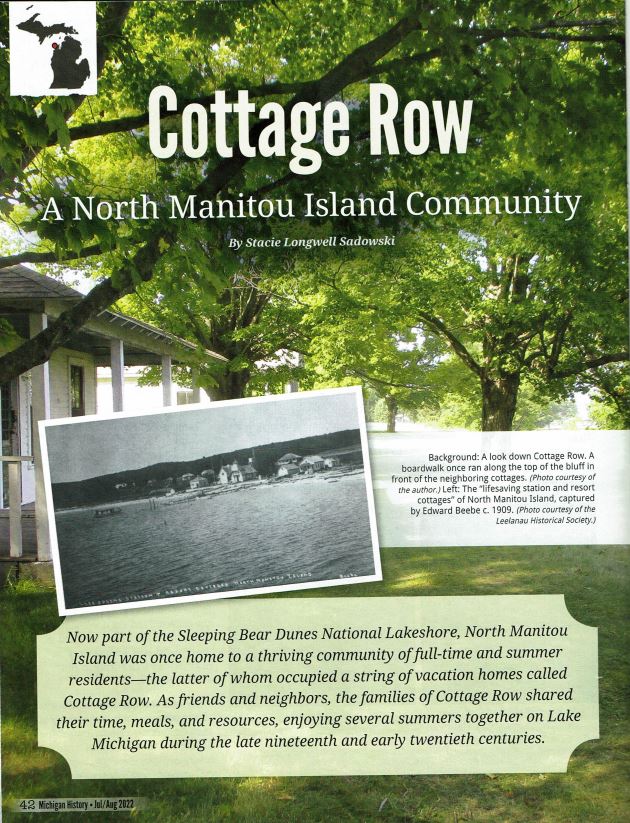
Imagine a perfect summer day on the shores of Lake Michigan, far from the city, at your family cottage surrounded by the cottages of your friends. What could be better? That was life on North Manitou Island for vacationers and summer residents in the early 1900s. Arriving by passenger steamship from Chicago, visitors on the dock made for a festive scene; men in suits and derby hats, women in long skirts with children in tow, and servants managing the steamer trunks. Their destination was a row of charming cottages at the edge of the small village, along a boardwalk overlooking the lake.
Today thousands of backpackers annually visit North Manitou Island in the Sleeping Bear Dunes National Lakeshore. There, a series of historic summer cottages on a bluff overlooking Lake Michigan speaks of a time gone by. While most of the buildings are now closed and unused, and have been for decades, they were once part of a thriving island summer community called “Cottage Row”, which was at its height of activity from the 1890s to the early 1910s. Cottage Row sat near a lifesaving station, a saw mill, and commercial farming operations, together making up the village area on the island’s east side.
How it Began: A Summer Retreat among the Farmers and Loggers
In the late 1800s, North Manitou Island was mostly settled by loggers, farmers, and the lighthouse and lifesaving station crew members. Easy access to ships on the lake opened up markets, making for successful milled lumber and agricultural product trade. Lumber operations and farming homesteads flourished, peaking at about 400 people during the busiest years. European immigrants arrived to work in the lumber industry, with some staying to establish homesteads. The lifesaving station added stability to the island economy, and was vital for safety on the Manitou Passage, a heavily traveled shipping lane between the island and the mainland.
As was common in other northern Michigan locations, lake travel made the island an easily accessible destination for summer vacationers from Chicago. At the time, Chicago was a busy metropolitan area with bustle, noise, and water pollution. Families with financial means were able to leave the city during the summer, possible for many of the middle class. Wives and children would spend the season away at a cottage, and husbands would join occasionally as business allowed. Passengers could conveniently travel by steamship and arrive at the island within a day, much quicker than travelling over land.
In the early 1880s, one such Chicagoan, Silas Boardman came to North Manitou and began a commercial farming operation. As a retired banker, he decided to move northward in search of a healthier environment. Combining both business and pleasure, Boardman had a plan to generate income from raising livestock and create a summer retreat for his family. His daughter Carrie married George Blossom, who also became an island regular. One summer, Carrie suggested to her neighborhood friends that they all visit her parents on the island. After having a pleasant time with their guests, the Trudes and the Footes, they came up with an idea. What if they could all continue to vacation together each year, owning their own cottages as neighbors? The idea took off, and by the end of the vacation, the couples had developed a business plan.
They made a deal with Carrie’s father Boardman, and purchased a tract of land for $500 that they could sub divide for sale to their friends. The land included 10 plots, 300×100 feet each, that sat on the low bluff overlooking Lake Michigan and the Manitou Passage. The owners could build cottages and have access to a shared 18 acre common area in front of the bluff, for use as a park for beach relaxation and cabanas. Purchase also included use of a dock on Lake Michigan and a boat landing on inland Lake Manitou. Fredrick Trude, a lawyer, drew up the legal documents. They quickly recruited their Chicago friends to purchase land along with them, and excitedly began working to make their dream come true.
The Golden Age of Cottage Row
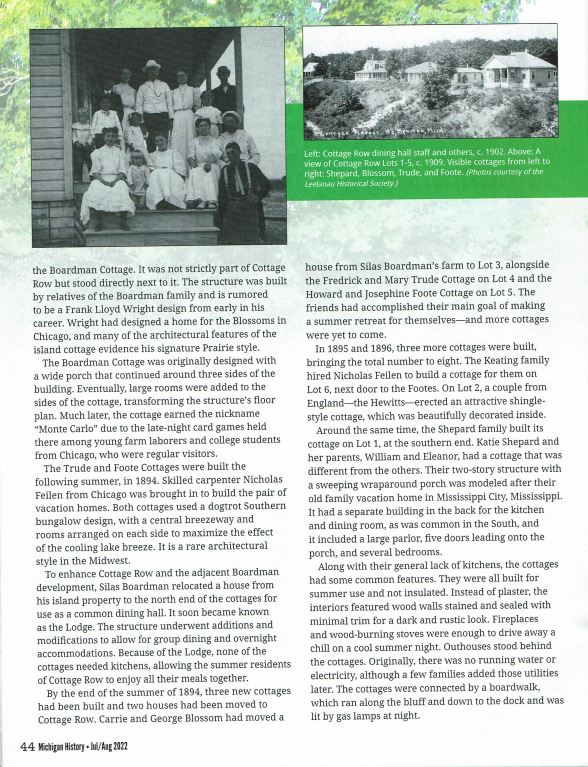
The plan for the Cottage Row development took off quickly after that summer visit of 1893. Within just a few months, a cottage was erected on the bluff: the Boardman or “Monte Carlo” Cottage. It was not strictly part of the Cottage Row plot, but directly next to it. The cottage was built by relatives of the Boardman family, and is rumored to be a Frank Lloyd Wright design from early in his career. Wright had designed a home for the Blossoms in Chicago, and many of the architectural features of the island cottage suggest evidence of his signature prairie style. It was originally designed with a wide porch that continued around three sides of the house. Eventually, large rooms were added to each side on the porch, transforming the floor plan. Much later, the cottage earned the nickname “Monte Carlo” from late night card games among young farm laborers, college students from the city, who were regular visitors.
The following summer of 1894 was a busy season with both the Trude and the Foote cottages being built. Skilled carpenter Nicholas Feilen from Chicago was brought in to build the pair. Both cottages used a “dog trot” southern bungalow design, with a central breezeway and rooms arranged on each side to maximize the cooling breeze from the lake. It is a rare architectural style in the Midwest.
As part of the whole Cottage Row and adjacent Boardman development, Silas Boardman relocated a house from his property to the north end of the cottages for use as a common dining hall. It soon became known as the Lodge. Additions and modifications were made for group dining and space for additional overnight accommodations. None of the cottages would need kitchens, allowing for the summer residents to enjoy all their meals together.
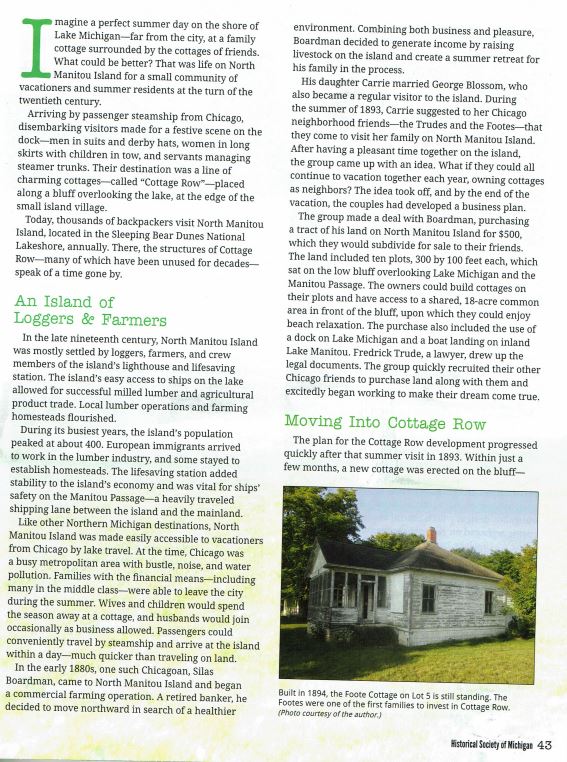
By the end of that first full summer, there were three new cottages built and two houses moved to the location. Carrie and George Blossom had also moved a house from Boardman’s farm area to Lot 3, alongside the Fredrick and Mary Trude Cottage on Lot 4, and the Howard and Josephine Foote Cottage on Lot 5. The friends had accomplished their main goal of making a summer retreat for themselves, and more houses were yet to come.
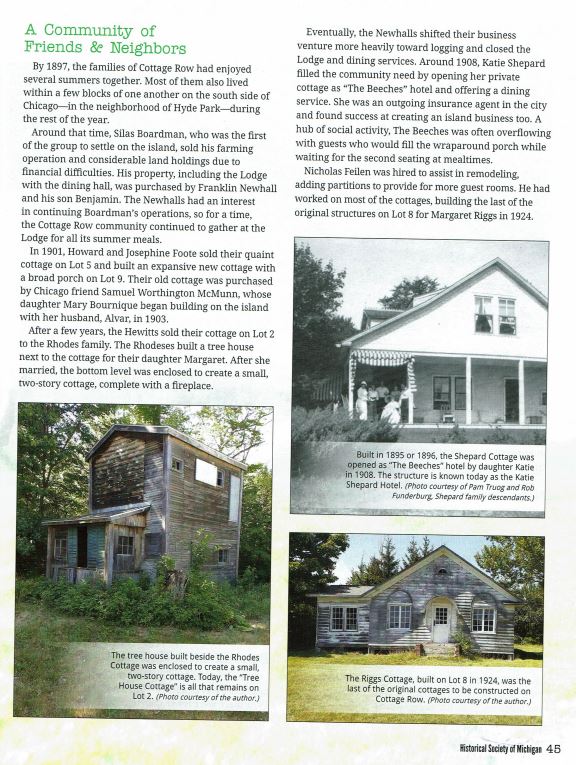
In 1895 and 1896, three more cottages were built, bringing the total number to eight. The Keating family hired Nicholas Feilen to build a cottage for them on Lot 6, next door to the Footes. On Lot 2 a couple from England, the Hewitt’s, erected an attractive shingle style cottage which was beautifully decorated inside. Around the same time, the Shepard family built their cottage on Lot 1, at the southern end. Katie Shepard and her parents William and Eleanor had a cottage that was different from the others. Their two story cottage with a sweeping wraparound porch was modeled after their old family vacation home in Mississippi City, MS. It had a separate building in back for the kitchen and dining room, as was common in the south. It included a large parlor and five doors leading onto the porch and several bedrooms.
Along with most having no kitchens, the cottages had some common features. They were all built for summer use and not insulated. Instead of plaster, the interior style featured wood walls stained and sealed with minimal trim for a dark and rustic look. Fireplaces and wood burning stoves were enough to drive away a chill on a cool summer night. Outhouses stood out back. Originally, there was no running water or electricity in any cottages, although a few added that later. The cottages were connected by the boardwalk along the bluff and down to the dock, beautifully lit at night with gas street lamps along the path.
By 1897, the families had enjoyed several summers together. Most of the families also lived within a few blocks of one another during the rest of the year on the south side of Chicago, in what is now Hyde Park. The wives socialized with one another and the children shared activities year round. Around this time, Silas Boardman, who was the first of their group to settle on the island, sold his farming operation and considerable land holdings due to financial difficulties. His property, including the Lodge with the dining hall, was purchased by Franklin Newhall and his son Benjamin. The Newhalls had an interest in continuing Boardman’s operations, so for a time there was not much change for the Cottage Row families. They continued to gather at the Lodge for all their meals and enjoy their community.
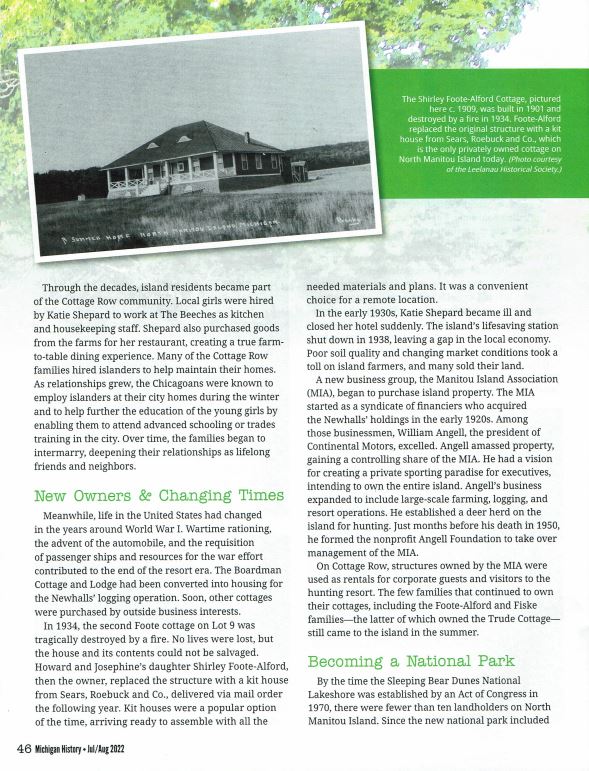
In 1901, Howard and Josephine Foote branched out and built a larger cottage. They sold their quaint cottage on Lot 5 and built an expansive new cottage with a broad porch on Lot 9. Their old cottage was purchased by another Chicago friend, S.W. McMunn, whose daughter Mary Bournique and her husband Alvar began building on the island shortly after in 1903. The Bourniques had a large summer farm on the southern end of the island, obtained as a homestead claim. The Bournique family had a chain of ballroom dance studios in Chicago, and spent summers farming and horseback riding on their large property. The Bournique’s lived apart from the other Chicago summer families, but were known to be very social and traveled to the village often. At their property, they enjoyed the beautiful rolling grassy landscape and broad beaches not far from the lighthouse complex.
After a few years, the Hewitt’s sold their cottage on Lot 2 to the Rhodes family. The Rhodes built a treehouse next to the cottage for their daughter Margaret. After she married, the bottom level was enclosed using a variety of boards to create a small two story cottage, complete with a fireplace.
Eventually, the Newhalls shifted their business venture more heavily toward logging and closed the Lodge and dining services. Sometime around 1908, Katie Shepard filled the community need by opening her private home as “The Beeches” hotel and offering dining service. She was an outgoing insurance agent in the city, and was successful at creating an island business too. As a hub of social activity, it was common for guests to fill the wraparound porch waiting for the second seating at meal times. Nicholas Feilen was hired as a carpenter to assist remodeling, adding partitions to provide for more guest rooms. He had stayed on the island as a permanent resident, and had filed a homestead claim with his brother John. Feilen had worked on most of the cottages, building the last of the original structures in 1924 for Margaret Riggs on Lot 8.
In 1934, the second Howard Foote cottage on Lot 9 was tragically destroyed by fire. No lives were lost, but the house and contents could not be salvaged. His daughter Shirley Foote Alford, now the owner, replaced the structure with a Sears kit home from the Sears & Roebuck mail order company of Chicago the following year. Kit homes were a popular option of the time, arriving with all materials and plans, ready to assemble. It made for a convenient choice for a remote location, and with a smaller size that was easier to maintain.
Through the decades, local islanders from the farms were a part of cottage row life. Girls were hired to work at The Beeches by Katie Shepard, as kitchen staff and housekeeping. Shepard also purchased goods from the farms for her restaurant, creating a true “farm to table” dining experience. Many of the summer cottage families hired islanders to help maintain their homes. As relationships grew, the Chicago summer families were known to employ islanders at their city homes during the winter, and to help further the education of young girls by enabling them to attend advanced schooling or trades training in the city. Over time, the Cottage Row families began to intermarry, deepening their relationships as lifelong friends and neighbors.
New Owners and Changing Times
Life began to change in the years around WWI and beyond. Wartime rationing and the requisition of passenger ships and resources for the war effort contributed to the end of the resort era. The Newhall operation’s housing needs took over the Boardman Cottage and Lodge. Other cottages began to be purchased by outside business interests. Katie Shepard became ill, and closed the hotel suddenly in the early 1930s. The lifesaving station in the village closed in 1938, leaving a gap in the local economy without the lifesaving service members and their families to purchase island goods. Agricultural challenges of poor soil quality and changing market conditions took a toll, and many small farmers sold their land.
A new business group grew on the island and began to purchase land, the Manitou Island Association (MIA). The MIA started as a syndicate of financiers who acquired the Newhall’s holdings in the early 1920s. Among these businessmen, William Angell the President of Continental Motors excelled. Angell amassed property, gaining a controlling share of the MIA. He had a vision for creating a private sporting paradise for executives, with the goal of owning the entire island. The business expanded and included large scale farming, logging, and resort operations. A deer herd was established for hunting. Just months before his death in 1950, Angell formed the nonprofit Angell Foundation to take over management of the MIA. On Cottage Row, cottages owned by the MIA were used as rentals for the hunting resort or corporate guests. The few families that continued to own their cottages, including the Foote-Alford and Fiske families (owners of the Trude Cottage), still came to the island in the summers.
The National Park Service Era and Preservation of History
By the time the Sleeping Bear Dunes National Lakeshore was established by an Act of Congress in 1970, there were less than 10 landholders on the entire island. Since the new park included the South Manitou Island and large areas on the mainland, it took well over a decade to finalize land purchases. The Angell Foundation was one of the last to sell their North Manitou Island property to the National Park Service in 1983.
While this change brought about the end of many things on the island, the stories of islanders remain and are celebrated with new growth. With a patchwork of outcomes for landowners throughout the park, two parcels on North Manitou Island remain privately owned: the property owned by the Leland Public Schools, with recent plans to build a replica of the original school house south of Cottage Row, and Lot 9 of Cottage Row owned by the Foote-Alford descendants, who continue to enjoy and use their cottage.
The establishment of the park was a time of great uncertainty for residents and business owners in the entire area, with deep concerns about the impact on land ownership. Historical precedent allowed for improved properties to have a special status when considered for acquisition. Since the process to establish the park took nine years to move through Congress (1961 to 1970), properties continued to be built upon. A cutoff date was set. Any owner who had built on their property before December 31, 1964 had the option of continued ownership. Structures that had been built after that date were condemned, removed, and financial compensation offered for the property. The Foote-Alford families qualified for and chose continued private ownership. Other owners on the island who also had this right, for a wide variety of reasons sold their properties. The Foote-Alford family saw many changes over time, from a bustling community of summer residents, to a nearly island-wide private hunting resort, and eventually becoming surrounded by national park land.
Five other cottages remain standing and are cared for by the National Park Service, stabilized with plans for restoration. The Katie Shepard Hotel has been restored by Preserve Historic Sleeping Bear with hopes to reopen it as rustic overnight accommodations.
Although the sun has set and night has settled on the golden age of Cottage Row, it remains a protected place, welcoming thousands of visitors annually to walk along the path that was once a boardwalk to imagine the past.
Sleeping Bear Dunes National Lakeshore North Manitou History
SUMMARY OF COTTAGES:
| Lots from South to North | Cottage | Built | Current Condition |
| 1 | Shepard Cottage, later The Beeches Hotel | 1895 or 1896 | Restored |
| 2 | Hewitt Cottage | 1895 or 1896 | Main cottage removed, Treehouse Cottage Standing |
| 3 | Blossom Cottage | Moved to site 1894 | Ruins |
| 4 | Trude Cottage | 1894 | Standing |
| 5 | Howard Foote Cottage | 1894 | Standing |
| 6 | Keating Cottage | 1895 | Removed |
| 7 | Vacant | ||
| 8 | Riggs Cottage | 1924 | Standing |
| 9 | Shirley Foote-Alford Cottage | 1901, 1935 | Original cottage destroyed by fire in 1934, second cottage privately owned and in use |
| 10 | Vacant | ||
| Unnumbered | Boardman “Monte Carlo” Cottage | 1893 or 1894 | Standing |
| Unnumbered | The Lodge and dining hall | Moved to site early 1890s | Destroyed by fire 1953 |